Home

“Conditioned” Attics

8 Comments

(Image stolen from the internet.)

I will first confess that I have not done a lot of hard research on this topic.  I simply don’t have the time. The question has come up so often that I thought I would just brain-dump what I do know.  Think of this article as “How I would design my own house”.  Not necessarily how you should do it and I’m certainly not critiquing anyone who chooses to do it differently.

First, I really try to avoid calling them “conditioned attics” unless I’m able to do the Dr. Evil air quotes while I’m saying it.  To me, “conditioned space” is somewhere you would want to spend a lot of time and be comfortable and therefor provide heated and cooled air.  The reason we condition our homes is to be comfortable.  Yes, these attics are within the conditioned boundary, the thermal envelope, etc.  That doesn’t mean they are or need to be provided with supply air.  The stud space between interior walls is inside the conditioned envelope as well, but I see no need to blow expensive supply air into my wall cavities.  Why waste perfectly good conditioned air where no one will spend any time?  These, like an encapsulated attic, are “indirectly conditioned spaces”.  They are conditioned by conduction and convection from “directly conditioned space”.  Yes, the mechanical code does refer to “conditioned attics”, but I think that is to easily indicate that they are unvented with the primary insulation is above the attic rather than at the home’s ceiling.  I do not think that the mechanical code is implying that these attics are or need to be kept at a certain temperature.  I do recall there being a code saying that you should not provide conditioned air to a space unless it had a certain fire rating, which amounted to sheet rock over the insulation and framing.  I suggest you research that in your area.

I know that in California the energy code (Title 24, part 6) gives you a big energy savings credit for having your ducts in “conditioned space” over having them in an unvented, insulated (encapsulated) attic.  So, many people say, “Well, if we just put a supply register up there, we can call it conditioned space and take the credit.”  Last time I checked, the folks in charge frowned on that.  This topic really, really needs to be clarified.

I personally do not think it is a good idea to share attic air with the house no matter how well sealed and insulated it is.  Now, I’m talking about an attic where, when looking into it, you can see the insulation at the roof deck and you can see the backside of the sheet rock on the ceiling and all the wood framing and wiring and such.  Is that a place you would want to spend a lot of time, even if it was a comfortable temperature?  If your child wanted to move their bedroom into the attic, would you let them?  I wouldn’t, unless it was sheet rocked, taped, textured, painted and provided with lights, ventilation, a safe ladder/stairs, etc.  But then it would no longer be an “attic”, would it? 

My point is that the air quality in an attic is questionable, at best.  There is still a lot of discussion over the safety of spray-on polyurethane foam insulation (SPF) and off-gassing.  Which is how most people encapsulate their attic.  Even if you used a different type of insulation, would you want to breathe that?  Putting a supply register in the attic without any exhaust ventilation in the attic is basically forcing attic air into your house. Even worse is putting a return grille in your attic.  By the way, I would seal my ducts extra well.

If it were my house I would ensure a one-way path of airflow from the house to the attic then outside, never from the attic to the house.  ASHRAE 62.2 provides guidance on ventilating homes for indoor air quality (IAQ).  It requires a certain amount of outside air to be introduced to the home.  Though it can be combined with local exhaust for bathrooms and kitchens, I prefer not to.  It can be a relatively small, continuous flow of air into and/or out of the house (supply, exhaust, or balanced).  It needs to have a switch to turn it off in case of poor outdoor air quality.

This is how I would do it if I were designing my own house with an encapsulated attic: I would provide continuous supply ventilation to an extra deep return boot as shown in the diagram, below.  I would only deliver just enough to satisfy the ASHRAE 62.2 requirements for OA.  I would also put a fan of the same size, maybe a little bigger, in the attic to exhaust the attic air to outside.  This would ensure that the house is positively pressurized relative to the attic.  If the house were super tight, I would put a pressure relief grille in the ceiling between the house and the attic with a backdraft damper.  I would try to put it at the opposite end of the attic from the attic exhaust fan.  Having house air exhaust through the attic would help keep the attic closer to house temperature without wasting supply air.  One could argue that this is balanced ventilation because it provides both supply and exhaust to/from the house, which ASHRAE 62.2 allows you to deliver even less than just supply or exhaust.  I’m not against outside air.  I just think that dilution is not the only solution to pollution.

Some comments on this type of supply OA ventilation: It is much preferred over the more common exhaust ventilation because you know exactly where the air is coming from.  It is unconditioned air, so you don’t want it to blow on people or have it affect the thermostat prematurely, and it has to be filtered.  I’ve designed systems like this that were installed in production homes.  One time I asked a homeowner how often they changed the little filter.  They said, “Oh, we never have to.  It never gets dirty!”  I reminded them that the dirt collects on the back side – the side you can’t see.  They said, “Oh.  I better go check it.”  Dumping the outside air here allows it to be very well distributed in the house when the system is running, which, if properly sized, should run a lot on really hot or cold days.  Dumping it upstream of the main filter has the advantage of greatly reducing the impact of the main system blower fan increasing outside airflow.

I’d love to hear how you would do it in your own house and why.

Russ

—————————————————————–

Addendum, based on feedback from colleagues:

A couple points that I should have made clearer in the post:

  1. This is for a hypothetical new construction house that I might build on our property in northern CA (hot-dry climate). 
  2. It would be an accessory dwelling unit (ADU) of about 1200 sf.  I would make sure that the house and roof deck are very well sealed.  Since the house is only 1200 sf and 3 bedroom with balanced ventilation.  The minimum continuous OA rate is only around 50 cfm.

The supply fan is continuously pushing fresh air into the house.  The exhaust fan in the attic is continuously pulling air from the house via the one-way damper in the ceiling, across the attic and out.  They are on the same switch in case they need to be turned off, but the are intended to run continuously.  The two fans would be essentially balanced and the house and attic would be essentially neutral pressure.  I was weighing whether it would be better to have the fan in the house or attic be slightly larger.  I’m opting for the attic fan to be slightly larger. I would size the one-way damper so that the attic is slightly more negative than the house.

The main reason I proposed this type of system is as an alternative to putting a supply register in the attic, but I think it has a lot of interesting benefits.  The fact that you are pulling a continuous flow of house air across the attic makes it more likely that the attic is close to the house in temperature without wasting supply air.  It’s a balanced ventilation system that avoids the cost, complexity and maintenance of an ERV/HRV.  It provides continuous attic ventilation.  Most people who install ERV/HRVs want to pull air from the bathrooms, not the attic.

All that being said, I think this ventilation design in this house would work fine in any climate, maybe not in a larger or more complex house.  Regarding the unconditioned OA being dumped behind the return grille in a hallway, an idea I’ve toyed with (in case there was a complaint in the homes we did this in) is some sort of one-way damper on the return grille to force the OA to go up into the ducts rather than down through the grille.  I think the air would be dispersed enough to not be noticed on mild days.  I’d have to think about the potential for condensation inside the ducts in very humid climates.  Perhaps a dehumidistat behind the return grille that turns on the central fan if it gets above a certain humidity.
What’s a Few Degrees Amongst Friends? – Picking A Summer Outside Design Temperature

9 Comments

The topic of today’s blog post is summer outside design temperatures and why you shouldn’t stress over them.  More precisely, there are other things far more important to stress over.

ImageA few years back, I literally had a contractor refuse to install my HVAC design solely because I chose a summer outdoor design temperature that was two degrees lower than what he thought it should be.  I was using the temperature required by the energy codes and recommended by ACCA and ASHRAE.  Granted, the project was a few miles away from the city that the temperature was measured for, and granted, it was on the other side of a small ridge.  Even if the “true” summer outside design dry bulb for the precise location of the project was 2 degrees higher than what I used, how big of a difference does that really make?  According to him, all the difference in the world.

His argument was that it would cause the A/C to be undersized and result in homeowner complaints that HE would have to deal with, not me.  First of all, as a licensed mechanical engineer, I am totally responsible for the performance of any mechanical plan that I stamp and sign.  Yes, he would be the first one they called, but if it turns out that my design was the cause of the problems, I would be responsible for fixing it and for paying for his time to respond to it.

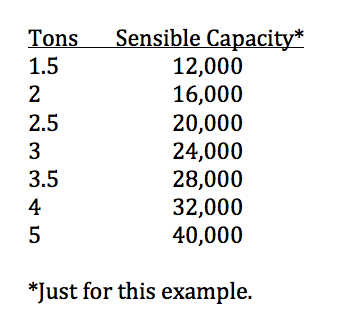
The first thing to realize is that typical residential A/C systems only come in a few sizes.  1.5, 2, 2.5, 3, 3.5, 4 and 5 ton sizes.  Roughly speaking these represent sensible cooling capacities of numbers something like 12,000, 16,000, 20,000, 24,000, 28,000, 32,000, and 40,000 btuh.  Basically, what happens is that you do your load calcs and then you pick the next size up.  So, if your sensible load is 13,000 Btuh, you would have to pick a two-ton because a 1.5 ton system would not be enough.  (Note: these sensible capacity values are very crude.  They are probably a little low.  I’m making them up because it’s easier to work with round numbers and I am too lazy to get some real numbers; however, real numbers would illustrate the exact same point.  Actual sensible capacities come from detailed performance tables published by the manufacturer and depend on indoor temperature and humidity, outdoor temperature, airflow across the coil and, of course, make and model.  Please don’t use these as rules of thumb.  I disavow any responsibility for them.  If you want to learn how to determine these for real equipment, read ACCA Manual S.)Image

For a typical 3 to 4 ton load in a fairly new home, changing the summer outside design temperature from 98 to 100 adds about 1,000 to 2,000 btu to the sensible cooling load.  The reason that it is a fairly small number is because the indoor and outdoor temperatures establish the temperature difference (delta-T) between the inside and outside of the house.  This delta-T only affects loads caused by conduction through the building shell (heat transfer through solid walls, ceiling, etc.) and convection into the conditioned space (outside air leaking into the house).  This delta-T has no impact on the largest single source of heat entering the house in the summer – solar gains.  Solar gains can be 30-40 percent of the sensible load and do not change due to outside temperature.  Neither do internal loads.

Did you know that a house with an indoor summer design temp of 75 and an outdoor summer design temp of 100 will have about the same cooling load as a house with an indoor summer design temp of 65 and an outdoor summer design temp of 90.  (65 is not a reasonable indoor summer design temp.  Don’t use that.  Use 75.  This was just another dumb example to make a point.)

So, let’s say your sensible cooling load calc at 98 deg is 29,000.  That would suggest a 4 ton system.  If you re-ran it at 100 deg and it went up to 31,000, a four-ton system would still work.  Your load calc at 98 deg would have to be over 30,000 before changing the temperature to 100 deg would even hint that you needed to go up to the next size equipment.  In this case, that would be a five-ton system.  So, lets just say for laughs that my load calc at 98 deg came out at 31,000.  If I caved to the contractor and reran the calcs at 100 deg, they would come out at around 33,000.  Too big for a 4 ton, so we would have to go to a 5-ton that delivers 40,000 btuh, sensible.

But, are we really doing the homeowner a service by putting in a system that is oversized by 7,000 btuh (21% excess capacity).  Wouldn’t it make more sense to really look at what this means and maybe try to find a way to make the 4-ton system work by dropping the load of the house back to 32,000?  (The answer is YES.  It would make tons more sense to do that.  Pun intended.)

Also, what exactly does the summer outdoor design temperature number represent?  Currently, we use a value called the “1% Summer Design Dry Bulb”.  It can be found for pretty much any city in California (there are about 750 listed) in the 2008 Joint Appendices, Appendix JA2.2.  What does the 1% mean?  Well, you can scan through Reference Appendix JA2 and by looking at cities you are familiar with, you will notice right away that it certainly doesn’t represent the hottest day of the year.  It’s usually well below that.  What it means is that the outdoor temperature is higher than that number only 1% of the time over however many years the data was collected for.  (Also notice that they list a value for 0.1%, 0.5% and 2%.  The code requires that you use the 1.0% value.)ImageAnother way of looking at this number is that 99% of the time, the actual cooling load is less than the load calculated using that temperature.  The system is perfectly sized for the few hours where the temperature is exactly the design temperature.  Let’s be generous and say that’s about 1% of the time.  This means that 98% of the time the system is oversized and will cycle on and off (or not run at all).

So, if our cooling load and cooling capacity were exactly the same, let’s say 32,000, then 1% of the time the load is greater than the capacity of the equipment and it cannot remove Btus as quickly as they are coming in.  When this happens, the temperature in the house will creep up.

If you didn’t know this already, a perfectly sized air conditioner will run continuously when the outdoor temperature is at or above the design temperature.  This is a good thing and the reason why is a discussion for a later blog, perhaps.  Just suffice it to say that cycling on and off is about as good for an air conditioner’s efficiency as stopping and starting is for your car’s MPG.

Let me also say this:  There is no such thing as a perfect load calculation.  They are a SWAG, which is only little better than at WAG (A WAG is a wild-ass guess.  A SWAG is a scientific wild-ass guess.)  Trying to calculate an exact sensible cooling load is like trying to measure the average diameter of a cotton ball with a micrometer.  Where do you draw the line?  The best you can do is document your assumptions and hope that you are right most of the time (99% is pretty good, by the way).

So, what ultimately happens during that 1% of the time when the A/C cannot keep up?  The indoor temperature shoots up like your car parked in the sun, your favorite leather chair burns skin off of your back, all the plants wilt, the goldfish are parboiled, and the kid’s crayons melt into pretty little puddles of color.  No.  None of these things happen.  What actually happens is the indoor temperature will creep up a few degrees.  If the set point is 75 degrees, it will rise up to 76, 77, maybe 78 degrees. (Seventy-eight degrees was the indoor design condition for many years by the way). How fast it takes to do that depends on the house.  One of the biggest factors is how much insulation and thermal mass the house has.  Thermal mass stores Btu’s in the winter and Bcu’s in the summer.  A “Bcu” is a Bubba’s Cooling Unit and it is equal to -1 Btu, see an earlier blog on that topic.

A fairly new, reasonably well-built house will rise about 1 degree per hour.  Whether or not that becomes a big problem depends on how hot it gets outside and how long it stays above the design temperature.

ImageThe above graph shows a hypothetical house that has the equipment sized exactly to the load.  Remember that this usually doesn’t happen when you pick the “next larger piece of equipment”.  Normally, there is some excess capacity in a properly sized system.

The red line is a typical pattern for outside temperature in the summer for a fairly hot city like Fresno or Sacramento.  This graph shows two consecutive “hot” days where the outdoor temperature exceeds the design temperature by several degrees for a few hours.  Remember, this only happens 1% of the time.

When it does happen, what happens to the indoor temperature?

The indoor temperature is represented by the blue/green/pink line.  When the line is blue, the indoor temperature is below the thermostat set point, of 75 degrees, for example.  This happens when it is cooler outside than inside.  When the line is green, the indoor temperature is right at 75 degrees.  This happens when the outdoor temperature is above 75 degrees but below the outdoor design temperature.  When the line is pink, the indoor temperature is above 75 degrees.  This happens when the outdoor temperature is above the outdoor design temperature.  Notice that if these were weekdays, the pink bump is happening mostly when no one is home.

Something else to realize is that when the line is blue, the A/C is not running at all.  When the line is green, the A/C is cycling on and off.  When the line is pink, the A/C is running continuously.  Interesting?  I think so.

So, does that graph represent something that the typical homeowner would complain about?  Possibly.  Homeowners have a right to be picky.  They are spending a lot of money on their home.  Are there things a homeowner can do to make sure this doesn’t happen (without changing the size of the A/C)?  Absolutely.  Remember, this only happens on the few hottest days of the summer and in a system with no excess capacity.  Most homeowners know when hot days are going to happen and can take reasonable precautions.

Most cooling loads are calculated with the assumption that some or all of the interior shades (drapes, etc.) open.  Keeping all of the drapes closed during hot weather makes a huge difference.  Planting shade trees around a house makes a big difference.  Even neighboring buildings provide shade not accounted for in the load calcs.  Pre-cooling or overcooling the house can help too.  This is when you set the A/C down a couple extra degrees, cooling the house down a little extra at night, and letting the thermal mass of the home help keep it cool during the hottest time of the day.

Did you know that a house with less thermal mass will have a taller hump in the pink part of the line.  A house with more thermal mass will have a flatter hump.

The vast majority of homeowner complaints about cooling that I have dealt with did not stem from undersized equipment and certainly would not have been solved by using a higher outside design temperature.  They stemmed from poorly built homes (leakier than expected, poorly installed insulation, etc.), underperforming cooling systems (poor refrigerant charge, low airflow due to undersized ducts, leaky ducts, etc.) and poor thermostat operation (turning system on and off and not letting it reach equilibrium).

ImageThis graph represents a more normal hot summer day.  Where it does not quite reach the design temperature outside.  These are far more common than the previous example.  Notice that there is no pink bump where the indoor temperature drifts up.  Realize though, that the lower the outdoor temperature is, the more often the system will cycle on and off.  This reduces efficiency.  The ultimate question then becomes, is it worth having a less efficient system the vast majority of the time just to prevent the indoor temperature from creeping up a few degrees on very hot days (which can be prevented with simple precautions).  I vote no, but that’s just me.

By the way, the same contractor that I mentioned at the beginning of this blog also told me that a 16” return duct is fine for a 4-ton system (hint: that’s not even close).  So, the moral of that story is: stop quibbling over things that we cannot control, like the weather, and start quibbling over things we can control, like quality construction, quality system design, good air flow, and proper thermostat operation.