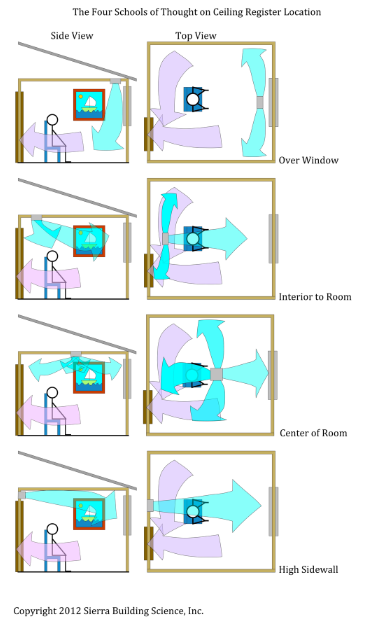
As promised, here are the “Four Schools of Thought on Ceiling Register Locations”. See diagram below. OK, so the fourth option is technically not a ceiling register, but it is often used as an option.
First some assumptions: 1. slab on grade house, floor registers are not an option; 2. It is a standard sized bedroom with a door on one side and a window on the opposite wall; 3. the return grille is outside the room; 4. the diagrams show cooling airflow (heating would be similar.
The blue arrows are the primary flow direction, which is the direction of the airflow caused by the velocity and momentum of the air as it leaves the register. The purple arrows show the secondary flow direction, which is the direction of the airflow after it has lost its initial velocity. Another way to think of secondary flow direction is the direction the air already in the room moves right when the system fan turns on. Generally speaking, this is the direction the air is going to go to reach the return grill.
I’m sure all of you are dying to know which one of these is the best! Well, I hate to burst any bubbles but, when done correctly, they all are very, very close. They all have pro’s and con’s, which will be discussed over the next few posts, but in terms of comfort, which is based on even temperature in the room, they are all very close.
Notice that I was very careful to say “when done correctly”. It is very easy to screw up any one of these by using the wrong type of register. The first option should always be a two-way register, never a three-way or one-way. The second option should always be a three-way, but one-way registers can work too. It should never be a two-way. The third option should always be a four-way, possibly a three-way or circular (radial) register. The fourth option should always be a bar-type register directed perpendicular to the wall.
 Duc-Bloc register blocks for duct testing
 HVAC 1.0 Book – Introduction to Residential HVAC Systems
 Kwik Model 3D HVAC Design Software
 Russell King, M.E.
Dec 20, 2014 @ 06:58:15
Fantastic summary of the options! Any plans for similar options for areas with about the same amount of days running heat and cooling? I’m currently 0 for 3 HVAC contractors in the area (Central Illinois), and while I have a great deal of fluid dynamics in my background (chemical plants), I’m always looking for the ‘experienced’ to keep from re-engineering mistakes.
Dec 24, 2014 @ 17:42:00
Hi Keith,
Sorry for the slow reply. These all still apply. The main goal for all systems is mixing. Mixing. Mixing. Mixing. When the air is the mixed it will not stratify. One thing that helps is to blow the air the opposite direction that it wants to go. Blow hot air down. Blow cold air up. You might consider running heating mode on a higher speed tap than the default setting. This will cool the air down a little and promote better mixing.
Happy Holidays!
Russ
May 09, 2024 @ 12:46:10
This is a great ppost
May 13, 2024 @ 11:00:30
Thanks, Michael.
Aug 05, 2024 @ 12:41:55
I am a professional historic contractor restoring a 100 year old house in Northern NJ and while the walls and ceilings are open, I am installing ducts for AC only. I was a 20+ year subscriber to Fine Homebuilding and JLC magazines and have not been able to find an answer to my installation question on either of those websites / forums. My question is: on the first floor I have the option to install ceiling registers either on exterior or interior wall, but due to existing framing and door locations on the second floor (which are not movable), either application will require corner locations. There is a living room and dining room that share an interior wall with a large opening between them. I read all your posts on the 4 different locations and understand the pros/cons of each but you do not address corner installations. Is there one preferred location with interior vs exterior corner locations? Should I install on exterior walls which would put each vent furthest apart (which is most similar to your “over window” scenario) OR back to back on the shared interior wall which would put them in the center of the house (similar to your “center of room” scenario)? Exterior walls are insulated with open-cell icynene and all walls are finished with 5/8″ QuietRock drywall, vapor barrier primer, 1/8″ skim-coat plaster and lime paint. Interior walls are 1/2″ and ceilings are 5/8″ QuietRock drywall (both are finished same as exterior) joists are soundproofed with 8″ rockwool batts, and each room has one supply and one return ceiling register. I plan to install original vintage cast iron grilles which are non-directional and would basically dump air straight down, but am able to fabricate a sheet-metal directional diffuser in any configuration to install behind them if necessary. My HVAC subs I’ve been using for decades say location doesn’t matter in my application because the house is “tight” and rooms in question are open to each other and is basically “one big room” but that seems to be over simplistic. When I install roofing and siding I was taught to “be the raindrop” and envision where I (the raindrop) would want to go either naturally or when driven by wind. I tried to “be the cold airflow” in my situation but I can’t see a clear choice of one location over the other. Am I missing something obvious or am I overthinking this? I have one chance to get this right while I have everything open and don’t want to discover I made a rookie mistake in placement after the walls are finished.
Aug 07, 2024 @ 13:40:26
Hi Craig,
In a well designed system (equipment not oversized and ducts properly sized for good total airflow and room to room balance) location of registers is far less important. The purpose of my 4 schools of thought was to show that any of them can work well if done correctly. The fact that your registers are only partially directional and probably don’t have any engineering data (throw, noise criteria, static pressure drop, rated cfm, etc.), I would say that it is important to play it safe and get the air out near the exterior walls. The industry standard for sizing and placing registers is ACCA Manual T. The priorities to consider are: 1 minimize static pressure drop. 2 mixing, 3 no stagnant areas, except corners, 3 don’t blow directly on peoples heads. As you’ve probably figured out, there is no perfect spot. You have just try to maximize the benefits and minimize the negatives. P.S. I cannot overemphasize the importance of not oversizing the equipment. Oversized equipment will be off much longer. This makes it very difficult to address any of the priorities, except #3.
Russ
Dec 01, 2024 @ 09:56:44
Hi, I’m not a specialist or even own a home. I actually found your site after trying to find about air flow/circulation throughout my craft room (spare bedroom) in my apartment. To my surprise the first diagram is the layout. I kept wondering despite the rest of the place being cool in summer and warm in winter my room always seemed to have trouble. Of course there’s obvious cheap window installation, in which I had to do some research and additional insulation that seemed to help a little. But the air still seemed hot and stuffy up until the temperatures dropped. The room isn’t crowded. I actually have a HEPA air cleaner that I always run and I just recently bought a portable dehumidifier. Is a portable fan the only way to keep the room from feeling stuffy? Help!
Dec 01, 2024 @ 16:13:48
Hi Diane,
Chances are it is a load vs airflow problem. The airflow in the room is not enough to offset the load (heat gain). Reducing heat gain and increasing airflow are probably your best best. If the room is on the south or west side of the house, try putting some kind shading on the window to block the solar gains (heat from sun). An exterior shade like a sunscreen, awning, or even a tree (if you can) is preferable. After that, interior shades such as roller shades or mini-blinds kept closed should help. As an experiment, take the register off the ceiling and try it like that for a while. That should improve airflow into the room. Use the fan to circulate the air. If that helps, try replacing the register with t a bar-type register. Here is an article on the topic. https://russellking.me/2019/06/23/a-quick-and-easy-diy-for-improving-air-flow-in-a-home/ Leave the door to the room open when possible. Closing the door can reduce circulation in the room. Lastly, look at how many electrical devices you have running in the room. Try to reduce that. Converting lights to LED can help. Anything that uses watts is basically adding heat to the room.
I hope this helps.
Russ